
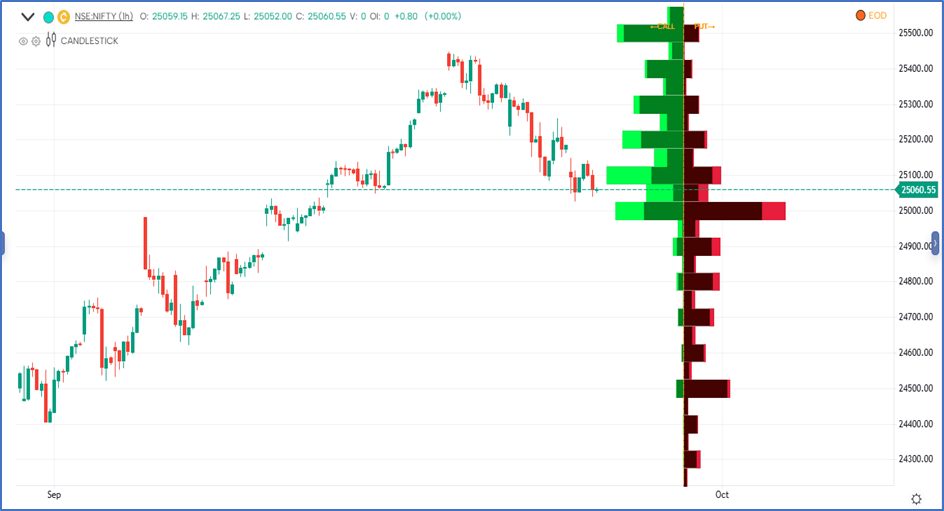
Successful intraday trading is rarely built on charts alone. Professional traders constantly combine multiple sources of market intelligence before making decisions, and one of the most valuable combinations involves reading overnight global sentiment alongside live domestic derivatives data.
For years, the SGX Nifty has served as an important indicator of how Indian markets may react before the opening bell. Although it offers only a preliminary outlook, it provides traders with an early glimpse into how international developments have influenced market sentiment overnight.
Once the Indian market opens, the Nifty Option Chain becomes the primary source of real-time information. It reflects where institutional traders are building positions, which price levels are attracting the highest activity, and how market expectations evolve throughout the trading session.
Used together, these two indicators help traders build a clearer picture of market direction before relying on technical charts or price action alone.
Reading Overnight Global Sentiment Before the Opening Bell
Financial markets never truly stop reacting to new information.
After Indian exchanges close, global markets continue trading while economic releases, geopolitical events, corporate announcements, central bank decisions, commodity movements, and currency fluctuations shape investor sentiment worldwide.
These developments are often reflected in the overnight movement of SGX Nifty, making it a useful reference for estimating how the Nifty Index may begin the following trading session.
A strong overnight rise generally signals the possibility of a gap-up opening, while sustained weakness often points toward a gap-down start.
However, experienced traders understand that the opening itself can reveal even more than the overnight move.
When the Actual Opening Tells a Different Story
The domestic market does not always mirror overnight sentiment perfectly.
If SGX Nifty indicates a significant positive opening but the Indian market opens with only a modest gain, it may suggest that domestic participants remain cautious despite global optimism.
Likewise, when overseas markets remain weak but domestic indices recover quickly after opening, it often indicates stronger local buying interest.
These differences between expected and actual market behaviour frequently provide valuable clues about the strength or weakness of prevailing sentiment.
In many cases, such divergences become early indicators of potential intraday reversals.
Understanding Option Chain Behaviour During the First Hour
The opening phase of trading is usually the most dynamic period for the option market.
As prices adjust to overnight developments, traders rapidly modify existing positions while establishing new ones based on evolving expectations.
These adjustments are immediately reflected in changes to:
- Open Interest (OI)
- Option premiums
- Trading volume
- Strike-wise positioning
Following a gap-up opening, call options near the current market level often experience intense trading activity as participants adjust hedging positions and reassess risk.
Meanwhile, put options that were previously close to the money may quickly lose value if the market opens substantially higher.
Monitoring these shifts during the first thirty to forty-five minutes provides valuable insight into whether institutional participants are supporting the initial move or gradually positioning for a reversal.
Using the Option Chain to Assess Gap Fill Probability
Gap openings attract considerable attention because markets frequently attempt to retrace part—or occasionally all—of the opening gap during the same trading session.
Although no gap is guaranteed to close, option chain data can help estimate the likelihood of such a move.
When a gap-up opening encounters exceptionally high Call Open Interest overhead, selling pressure from call writers defending those strike prices can slow upward momentum and increase the possibility of a partial gap fill.
Conversely, if substantial Put Open Interest exists below the opening level, put writers often defend those strikes by adding long exposure during declines. This buying support can reduce the probability of a complete gap fill and strengthen the market’s ability to sustain higher levels.
Rather than treating every gap equally, experienced traders study derivative positioning before deciding whether continuation or reversal appears more likely.
Matching Trading Strategies to Market Conditions
Every trading session develops its own personality.
Some days produce strong directional trends that continue from the opening bell until market close. Others remain confined within well-defined trading ranges despite an active start.
Combining overnight SGX Nifty signals with early option chain behaviour helps traders identify these conditions relatively quickly.
When strong overnight momentum is confirmed by rising volume, expanding Open Interest, and sustained buying after the opening, a trend day becomes increasingly probable. Momentum-based strategies generally perform better under these conditions.
On the other hand, when price struggles to extend beyond the opening range and the option chain reflects balanced activity between buyers and sellers, range-bound trading often dominates. In such environments, mean-reversion techniques and premium-selling strategies may prove more effective than aggressive directional trades.
Recognising the day’s character early allows traders to align their strategy with prevailing market conditions instead of forcing unsuitable setups.
Building Trading Confidence Through Daily Observation
Technical knowledge becomes genuinely valuable only through consistent application.
Maintaining a structured trading journal helps transform isolated observations into practical experience.
After each session, traders should review several important questions:
- Did the overnight SGX Nifty accurately indicate market direction?
- How did the option chain behave during the opening hour?
- Which support and resistance levels attracted the highest Open Interest?
- Did the market sustain its opening move or reverse later in the day?
- Which trading decisions proved effective, and which required improvement?
Recording these observations every trading day gradually develops pattern recognition that cannot be learned from theory alone.
Over time, repeated exposure enables traders to recognise familiar market structures more quickly and make decisions with greater confidence and discipline.
Final Thoughts
Successful intraday trading requires more than reacting to price movements after they occur. Traders who combine overnight global sentiment with real-time derivative data gain valuable context before making trading decisions.
SGX Nifty offers an early indication of international market expectations, while the Nifty Option Chain reveals how institutional participants respond once trading begins.
Together, these tools provide a structured framework for identifying market direction, evaluating gap openings, understanding support and resistance, and selecting strategies that match the day’s trading environment.
For disciplined market participants, consistently studying both indicators can significantly improve decision-making and strengthen long-term trading performance in India’s dynamic derivatives market.